Drive and record
One take, steered live with the keyboard and recorded as animation, then rendered in Forge with every hair.
 Procedural 3D for the age of agents
GeneraFX is a procedural modeller, animator and renderer with an AI agent at the controls. You say what you want; the agent builds the node networks, writes the C# that shapes the geometry and the GLSL that runs on the GPU, lights the shot and renders it.
The upright piano beside this text was built that way, down to the hammers and the strings, and a MIDI file plays it: every key and hammer moves with the notes, and the music you hear comes from the same file. Everything happens in the open, in nodes and code you can read, change and undo.
One take, steered live with the keyboard and recorded as animation, then rendered in Forge with every hair.
The agent started from the science: a red-knee tarantula, Brachypelma hamorii, a 53 mm body and a 14 cm leg span, seven segments to a leg, read from the species description and turned into a node network. It grew 150,000 hairs with Fur, longer on the abdomen, orange on the knees, rendered as real fibres.
Then the rig: a skeleton with the tarantula's own proportions, hinge IK so each leg bends only in its plane, and a Body Control node for height, pitch, roll, twist, walking and turning. The feet are planted where they land and never slide, whatever the body does.
The last part is yours. In the Drive panel you steer it live: W and S walk, A and D turn, the arrows lean it forward and shift its weight, R and F raise and lower it, or a gamepad. Drive and record writes every move as keys, one take on top of another, and each take is one undo step. A spotlight that looks at the spider follows it across the floor.
GeneraFX runs a Model Context Protocol server on your machine. An AI agent connected to it works inside the program with the same tools you have: it creates objects, wires the node networks that make the models, sets materials, lights and cameras, keys the animation, runs the simulations, looks at the views to check its own work, and renders stills, sequences and MP4s.
Help > AI assistant opens an agent already connected. You talk, it works, you watch the network grow in front of you. Every action is one step in the undo stack, so nothing it does is out of your hands; and when you prefer to move a light or a camera yourself, it picks up from there.
Writing a procedural shader used to mean knowing GLSL, the renderer's conventions and a good deal of maths. In GeneraFX you describe the surface and the agent writes the shader. The same code runs in the real time views, in Spark and in the Forge path tracer; on NVIDIA cards GeneraFX translates it to CUDA for OptiX by itself. You see the result in a second or two, and you ask again until it is right.
Geometry works the same way. Anvil is C# that runs on every point, every primitive or once per object, and the agent uses it wherever a node would be missing: a smooth lathe profile, a string of lights, a field of colours. Any param line in the code becomes a slider in the panel, so the knobs that matter are there for you to turn, without touching the code.
This is the top spinning in the clip below. The stone wall behind the torch, Voronoi stones with uneven mortar and real relief, came out of the same kind of request.
The points become bulbs with Clone to Points and an emissive material; out of focus, they are the bokeh behind the spinning top.
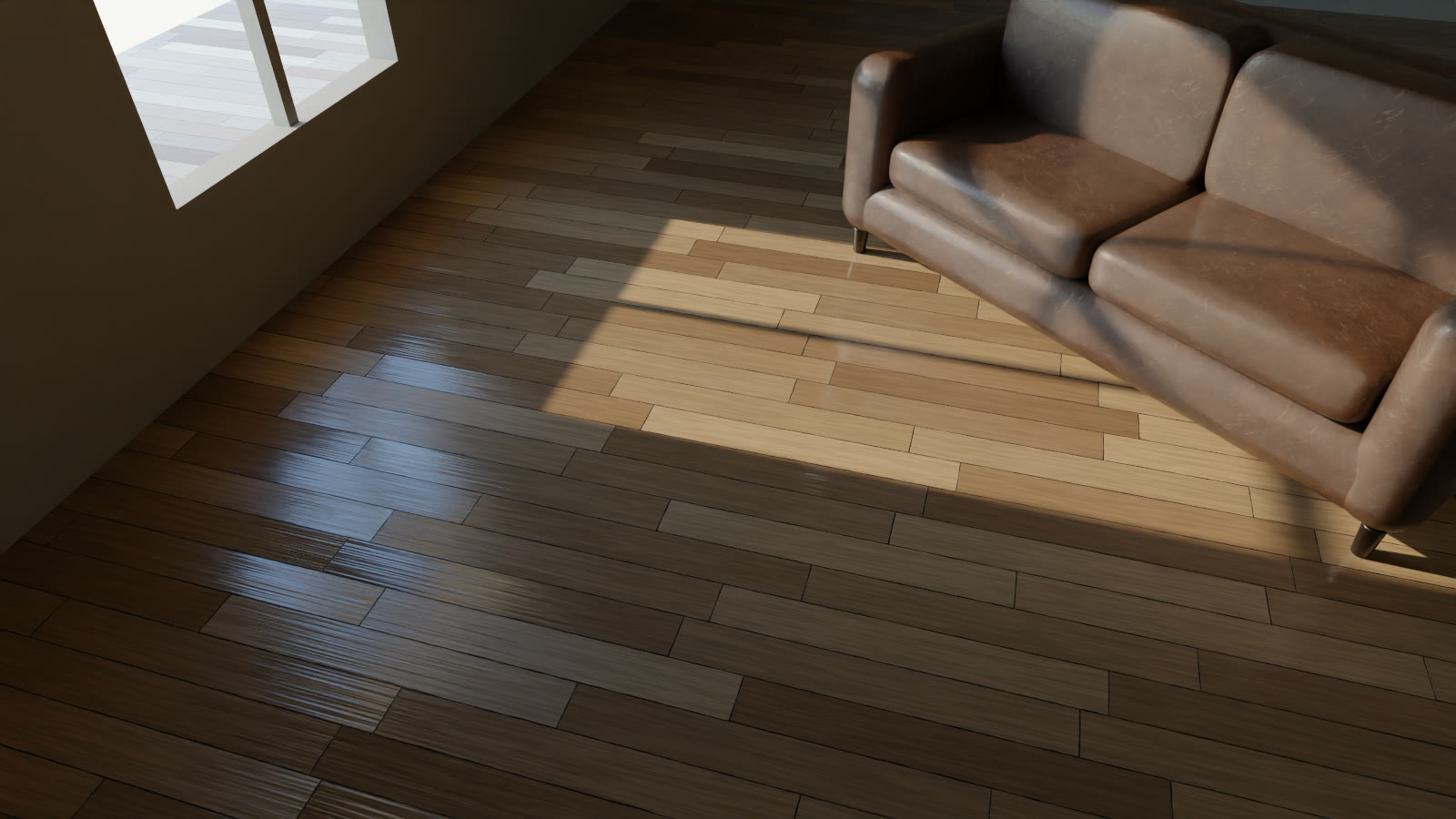
A floor from the GeneraFX library, written by an agent from a description and then refined by talking: “the reflection is too smooth, break it up with the grain”, “a little less”. Five laying patterns, uneven joints and bevels, grain and growth rings, a different tone for every plank, and a satin varnish whose gloss and bump follow the grain. The aged leather of the sofa is another shader made the same way, from a photo of a real sofa. Forge, sun through a window.
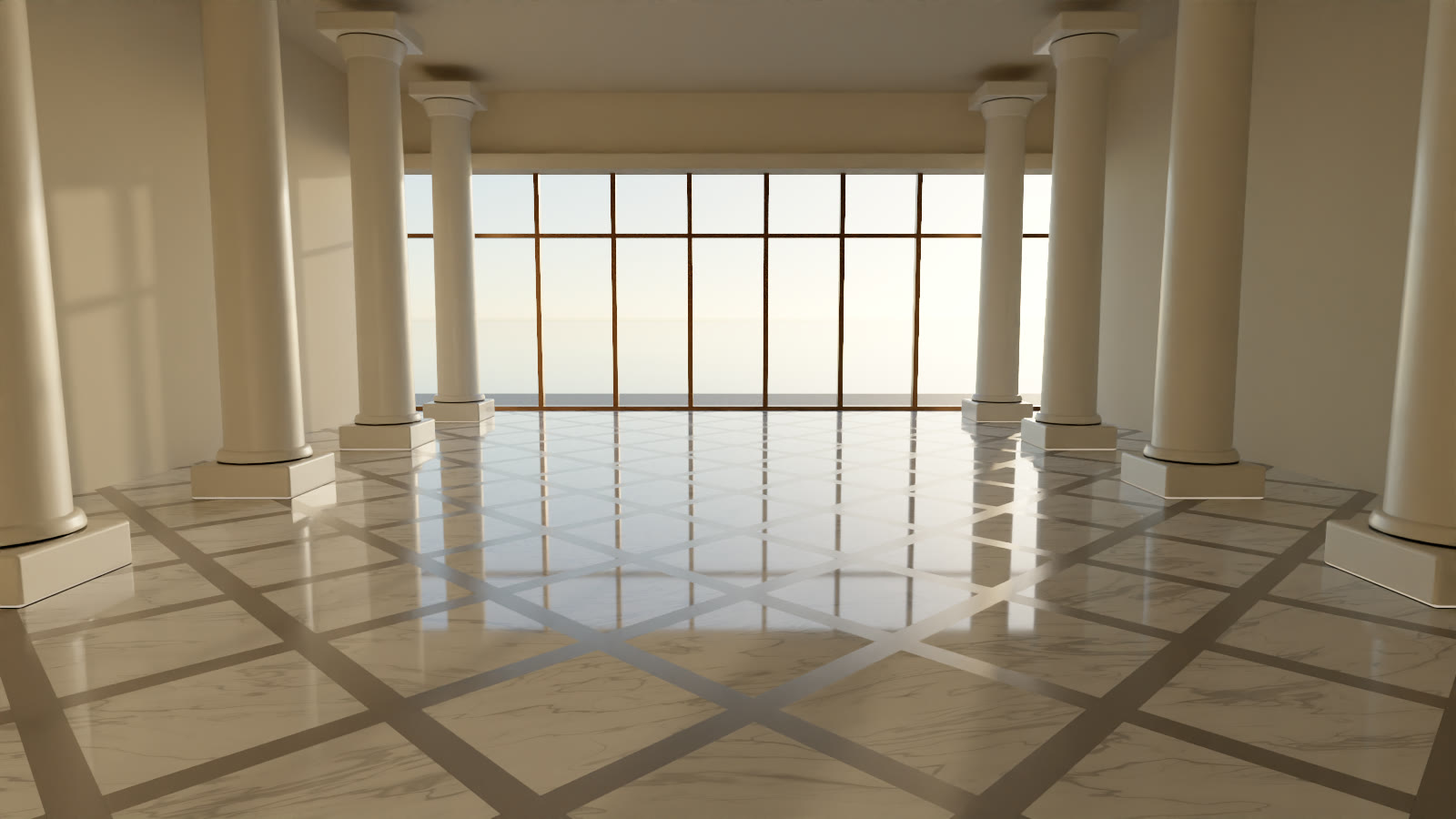
From a photo of a real hall: white marble slabs with grey veins, dark granite bands and squares where they cross, laid at 45 degrees. The veins are stretched noise with a soft halo plus Voronoi cracks, so every slab is a different cut of the block. A hall with columns and bronze glazing, built by the agent around it, low sun over the sea, Forge.
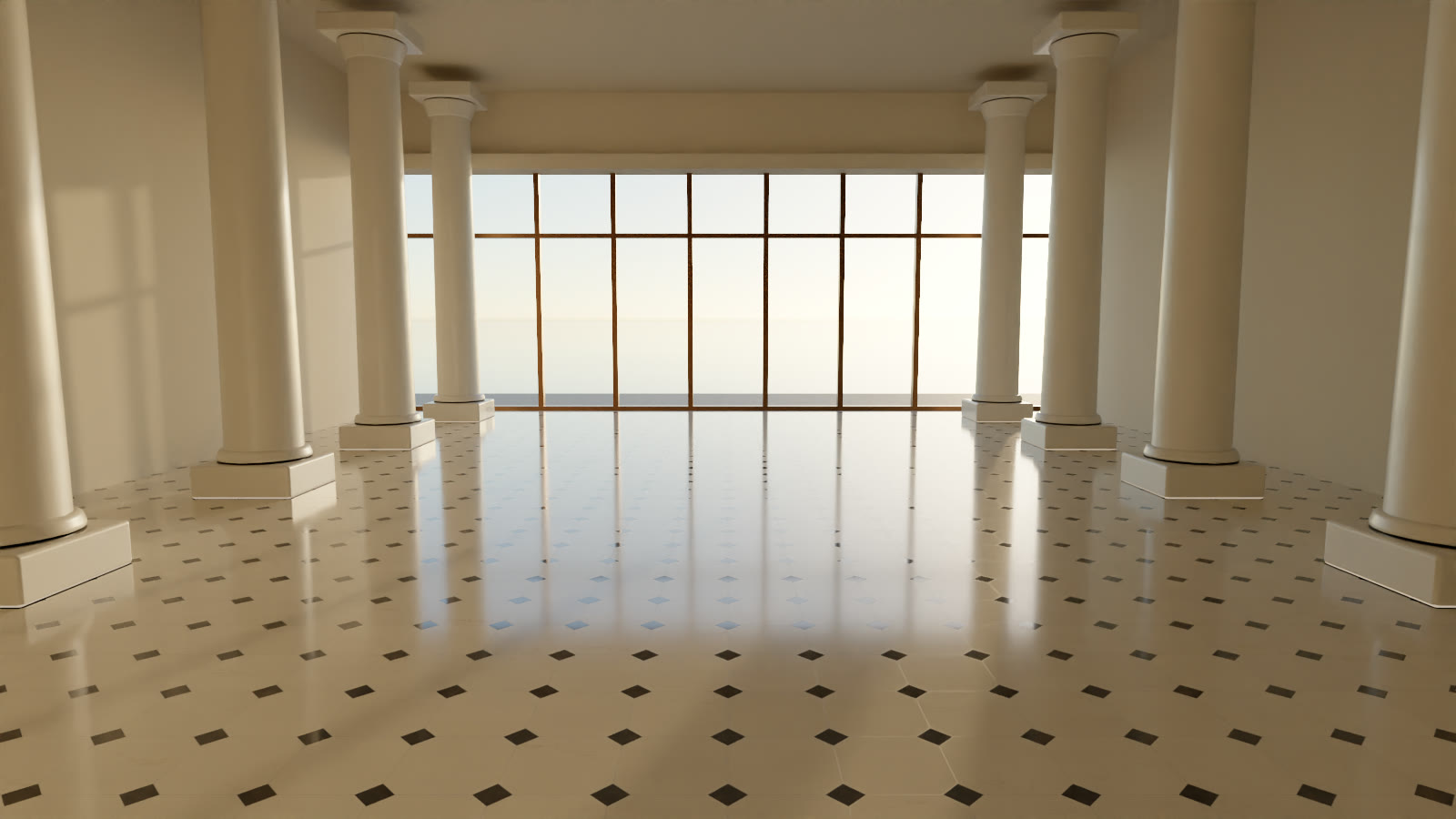
From another photo: cream marble octagons with faint golden veins, small black cabochons at the corners, light grout, each tile a slightly different tone. Same hall, the floor changed with one click.
Two levels, as in the big procedural packages: objects with their transforms, parents and paths, and inside each one a network of nodes where geometry flows from top to bottom. Every node is a pure function, inputs and parameters in, geometry out: easy for an agent to reason about, easy for you to follow. Change anything upstream and only what depends on it cooks again, in the background and in parallel.
The rest is modular too: the render engines, the physics, the native geometry kernel, the material compiler. Editing one material rebuilds only that material.
Undo on everything, subnets and network boxes, bookmarks, expressions on every parameter, and Variants: the network above it cooked N times, for N different trees, rocks or fruits from one recipe.
Millions of points and instances, nested, with level of detail in the views. Unchanged data stays the same data, so the views and the path tracer update only what really changed.
A new node is one C# class: menus, parameter panel, scene files and MCP tools pick it up by themselves, so the agent can use it the moment it exists. Drop a DLL into plugins and it is there.
The same materials and lights, three ways to see them: physically correct, in real time, or spectral. Switch engine at any moment; nothing in the scene has to change.
Runs on NVIDIA OptiX, or on any OpenGL card with the same images, pixel for pixel. Inside a view while you work, or to disk.
A deferred raster engine in the spirit of EEVEE, for the views, previews and fast renders.
GeneraFX connects to Glint, a spectral renderer that runs as its own node. Light is computed wavelength by wavelength: dispersion in gems and glass, thin films, real pigments. Pick Glint in the render settings and the scene goes there as it is.
A lacquered top spins at six turns a second, slows, wobbles and falls. The motion blur melts its colours, the lens turns the string lights behind it into bokeh.
No simulation: three nested objects (precession, tilt, spin) and one expression each. The resting angle comes from the profile of the top, so it lands exactly on its tip and rim, without sinking into the table.
Glazed ceramic, marble, stone and wood, every one a GLSL shader written by the agent, turning 360 degrees under the path tracer.
Every simulation is a node: it reads its inputs, keeps its frames in memory so you can scrub back freely, and gives geometry to whatever comes next. Every clip below is a Forge render at 64 samples, denoised, except the hair, rendered in Spark.
A FLIP solver with a pressure solve only where the water is, colliders of any shape, and a surface node that turns the particles into a smooth mesh. Here, water poured into a glass.
A grid solver for fuel, heat and smoke from any mesh, rendered as a true volume that lights the scene. The stone wall is one GLSL material: Voronoi stones, uneven mortar, real relief.
Jolt Physics inside a node: pieces from instances or connected parts, every frame cached and interpolated. A tower of blocks comes down.
Fabric that drapes and folds, cushions that keep their shape and bounce: stretch, bend, pressure and damping, with collisions against the rest of the scene.
Fur grown on any surface, groomed by clumps, length and curl, rendered as true fibres. Hair Dynamics swings the guides, and a Wind field moves hair, grass and trees together.
Emitters, forces, drag and collisions with any mesh: sparks that shoot, glow and bounce.
Boids with separation, alignment and cohesion, goals and obstacles: a flock wheeling around a tower of stone.
Skeletons, IK with poles, skinning, and a Walker that turns any legged creature into a gait from the time alone. A red-knee tarantula, built from measured proportions, with every hair.
Forty legged agents of two kinds walk over sand and gravel, keep their personal space and go round the rocks. Feet land where they really stepped, so nothing slides.
It is still in development, in the hands of a few testers. The call for new testers will go out on LinkedIn: answer there if you want to try it.